<img height="1" width="1" src="https://www.facebook.com/tr?id=3900557156680409&amp;ev=PageView &amp;noscript=1">
Skip to content
HoG_Additive_Manufacturing_RGB_box-1

3D Printing for the Aerospace Industry

Additive manufacturing enables the production of complex metal components for engines and aerospace systems. Hoffmann AM assists you in selecting materials and manufacturing processes, from engine casings to components for satellite systems. The appropriate solution depends, among other factors, on function, load, quantity, and operating conditions.

A combustion chamber component manufactured using metal 3D printing, featuring integrated ports and a diamond-pattern structure

What are the benefits of metal 3D printing for engines and satellites?

Complex Flow Paths

Additive manufacturing enables geometries that can be specifically adapted to a component’s installation space and function. Whether this allows for the integration of channels or the simplification of components depends on the specific design.

Integrate cooling channels

Cooling channels and multi-channel structures can be integrated into the part geometry. The material and design must be suited to the heat flow and operating conditions.

Select the appropriate material

Aluminum alloys, titanium, and nickel-based alloys may be considered, depending on the component requirements. Key factors include weight, temperature, mechanical stress, and the required certifications.

Metal Materials for Engine and Aerospace Components

The choice of material and manufacturing process depends on the component’s function and operating conditions. The following application examples illustrate various tasks in engine and satellite construction.

Fan housing for an aircraft engine

Additively manufactured fan housing made of AlSi10Mg for an aircraft engine

Multichannel Satellite Radiator

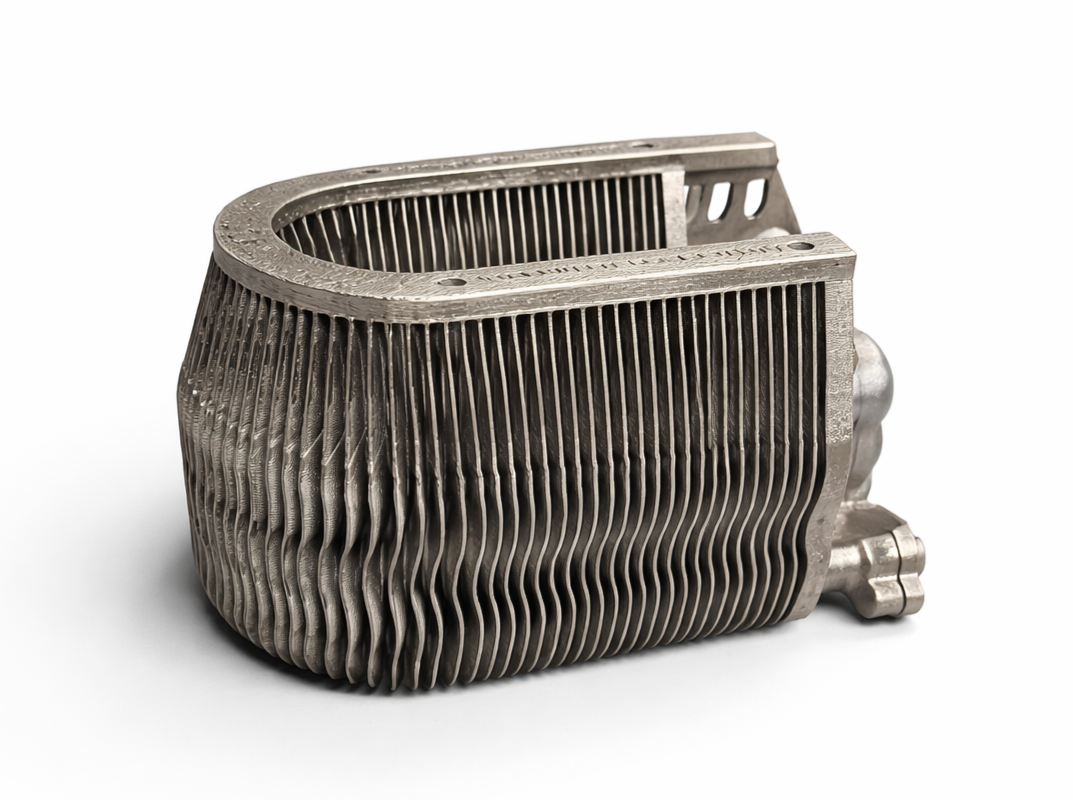
Multichannel satellite radiator made of Ti-6Al-4V titanium, 3D-printed heat exchanger with a finned structure

Frequently Asked Questions About 3D Printing in the Aerospace Industry

What components are 3D-printed for the aerospace industry?

For example, engine housings such as fan housings, heat exchangers, and radiators for regulating the temperature of satellites, as well as combustion chamber components that would conventionally be assembled from many individual parts.

What metals are used?

AlSi10Mg for lightweight housings, titanium Ti-6Al-4V for high strength and low density, and nickel-based alloys such as Inconel 718 for high temperatures.

How much does a 3D-printed metal part cost?

Here are two examples: A fan housing made of AlSi10Mg with a print time of 7.5 hours cost €900, while a titanium satellite radiator with a print time of 14 hours cost €970. The price depends on the geometry, material, quantity, and post-processing.

Can multiple individual parts be combined into a single component?

Yes. A combustion chamber component for rocket engines—which conventionally would have consisted of many parts—was 3D-printed from Inconel 718 as a single part, with integrated cooling channels.

What kind of post-processing is standard?

Metal components are stress-relieved and sandblasted. Connection and functional surfaces can then be CNC-turned and CNC-milled.

How do I get a quote for my 3D printing project?

Upload your CAD file to the online calculator to get an instant quote and delivery time. For complex parts or special requirements, we'll be happy to advise you personally.

Are you developing a component for the aerospace industry?

Please provide us with details on your component’s function, installation space, quantity, and operating conditions. We’ll help you evaluate materials, manufacturing processes, and post-processing options to ensure they’re suitable for your project.

Onur Yildirim, Head of Sales for Additive Manufacturing at Hoffmann AM
Ready for your first prototype? Talk to us.

Onur Yildirim

Head of Sales, Additive Manufacturing

 +49 89 83 919 898 

  3d@hoffmann-am.com 

 Fislisbach, Switzerland