<img height="1" width="1" src="https://www.facebook.com/tr?id=3900557156680409&amp;ev=PageView &amp;noscript=1">
Skip to content
HoG_Additive_Manufacturing_RGB_box-1

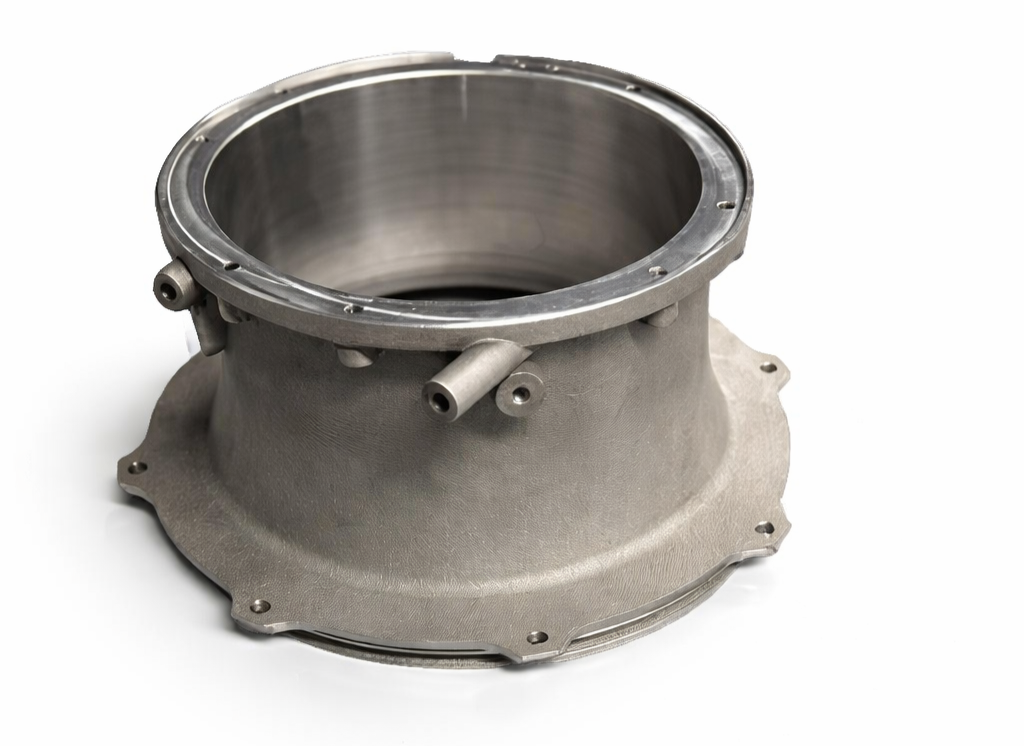
AlSi10Mg fan casing for an aircraft engine

A lightweight housing made of AlSi10Mg that guides and stabilizes the airflow in the fan section of an aircraft engine. Manufactured using metal 3D printing and CNC-machined at the mating surfaces.

When Airflow and Weight Matter

When developing an aircraft engine, the intake air must be guided in a controlled manner through the fan section. The housing encloses this section and connects it to the adjacent engine components. Its geometry influences how air flows through the engine and how the housing integrates into the overall assembly.

At the same time, the component must withstand the mechanical stresses of its intended use while remaining as lightweight as possible. Geometry, wall thicknesses, and connection areas must therefore be tailored to the specific engine configuration. A standard casing does not automatically meet these requirements.

This is where a fan housing produced via metal 3D printing can help.

Additively manufactured AlSi10Mg fan housing for an aircraft engine with CNC-machined mounting surfaces

The Solution: An Additively Manufactured Fan Housing

For this application, a fan housing is manufactured from the aluminum alloy AlSi10Mg. 3D printing makes it possible to specifically design the component geometry to fit the available installation space, the airflow, and the required interfaces.

After printing, the housing undergoes stress-relief annealing and sandblasting. Relevant areas are then finished using CNC turning and CNC milling. This allows the printed base geometry to be combined with precisely machined connection and functional surfaces in a single component.

Manufacturing Overview

The fan housing was manufactured using additive manufacturing from AlSi10Mg. It was then stress-relieved, sandblasted, and CNC-machined on selected surfaces.

Manufacturing Data

Material
AlSi10Mg


Layer Thickness
50 µm


Printing time
7.5 hours


Industry
Aerospace / Aviation

Post-processing

  1. Stress-relief annealing
  2. Sandblasting
  3. CNC turning and CNC milling of selected surfaces

Price of the manufacturing example shown: 900 €.
The price for a new project depends, among other things, on the part geometry, quantity, and desired post-processing.

What the 3D-printed fan housing makes possible

Geometry Based on Installation Space

The housing is designed to fit the available installation space, airflow, and interfaces within the engine, rather than adapting a standard part.

Lightweight and durable

AlSi10Mg combines low density with good strength. Wall thicknesses can be specifically tailored to the mechanical loads encountered during use.

Precise mounting surfaces

After printing, the connection and functional surfaces are CNC-turned and CNC-milled. This ensures that the housing fits precisely to the adjacent engine components.

Are you developing a component for the aerospace industry?

Please provide us with details on your component’s function, installation space, quantity, and operating conditions. We’ll help you evaluate materials, manufacturing processes, and post-processing options to ensure they’re suitable for your project.

Onur Yildirim, Head of Sales for Additive Manufacturing at Hoffmann AM
Ready for your first prototype? Talk to us.

Onur Yildirim

Head of Sales, Additive Manufacturing

 +49 89 83 919 898 

  3d@hoffmann-am.com 

 Fislisbach, Switzerland