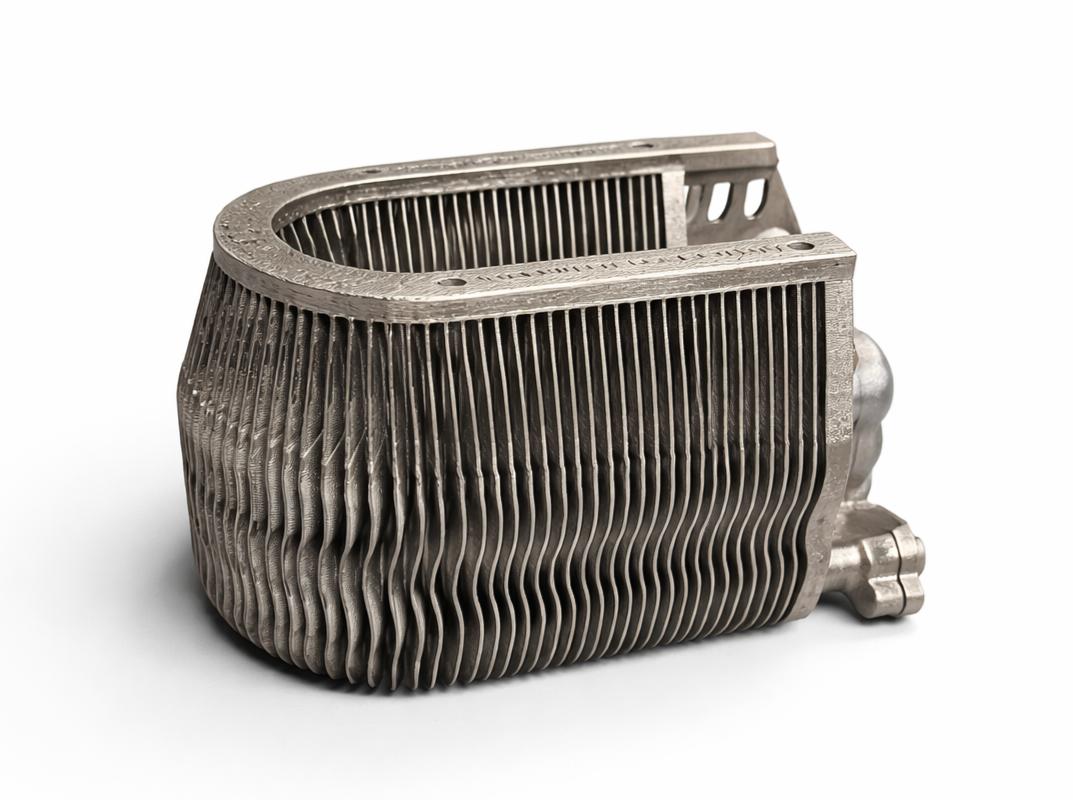
The solution: a one-piece titanium radiator produced using metal 3D printing
The radiator is built layer by layer from Ti-6Al-4V Grade 23. Cooling channels, thin-walled fins, and fluid connections are formed as a single piece, eliminating most joints. The geometry can be directly tailored to the installation space, thermal load, and interfaces within the satellite.
Grade 23 is the ELI (“Extra Low Interstitial”) variant of Ti-6Al-4V. It has high strength combined with low density, good fracture toughness, and minimal thermal expansion. However, titanium is a poor heat conductor. This is compensated for by thin walls and a large surface area, and the layer thickness of 40 µm is well-suited for these fine structures.
After printing, the radiator undergoes stress-relief annealing. This relieves residual stresses from the printing process to prevent the component from warping. During the subsequent sandblasting, the surface is made uniform, and any adhering powder is removed.