The protective cover remains open
The flat, custom-designed housing fits into the limited space on the machine frame. It does not protrude and does not interfere with the protective cover.
At an automotive supplier, door modules for various vehicle models are pre-assembled. At the assembly stations, clamping devices secure the door module while employees install components such as cables, window regulators, and trim parts. Sensors check whether key components are properly seated. Pneumatic clamping arms hold the door module in position during assembly.
Signals from the sensors and clamping devices converge in a compact I/O module. This module is designed to be mounted directly on the assembly fixture: This keeps cable runs short and ensures that the connections are accessible for maintenance work.
However, there is little space on the machine frame. A standard enclosure would protrude into the work area and interfere with the protective cover. Mounting it elsewhere would require longer cable runs and additional brackets.
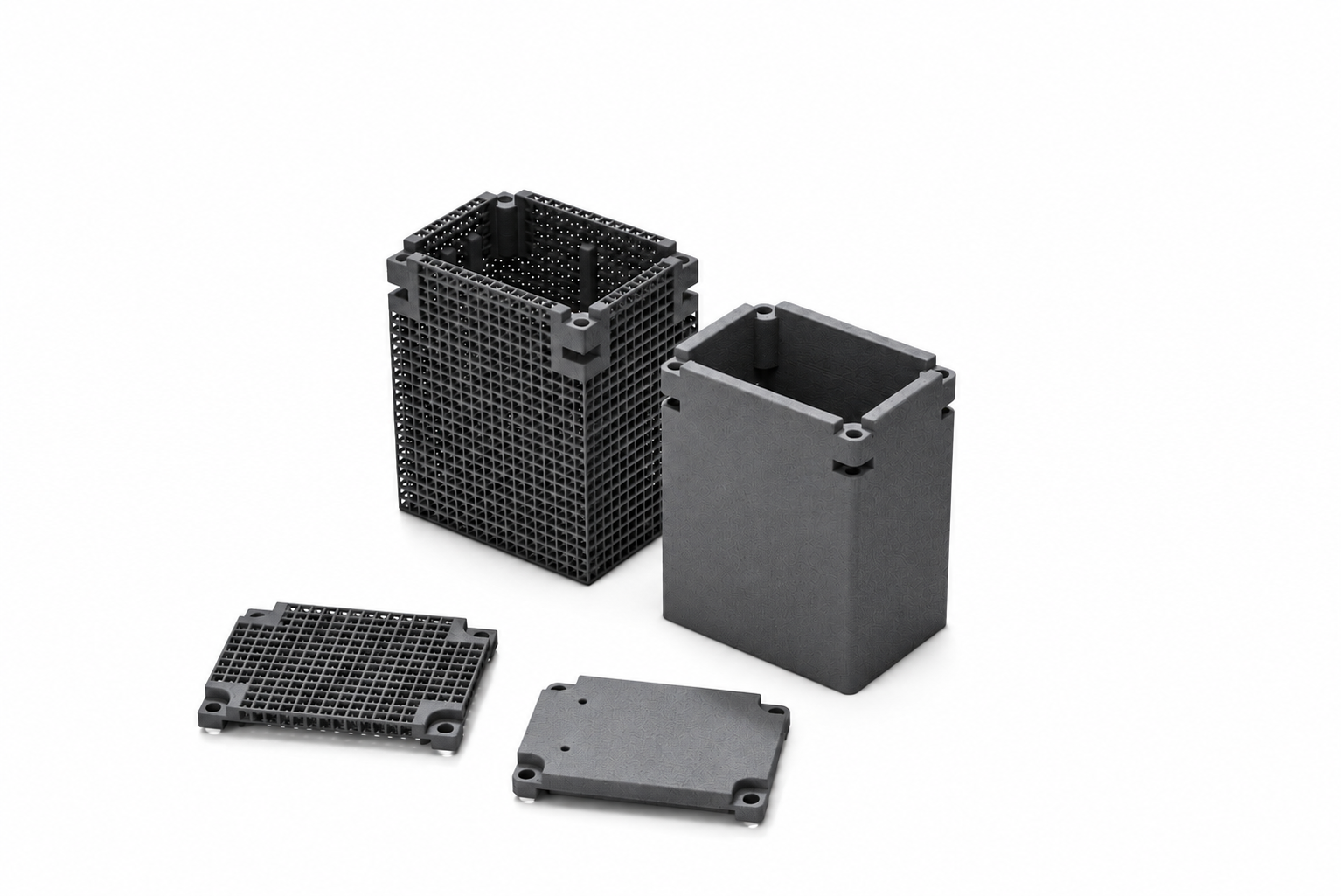
Twelve housing sets in two designs are manufactured for the twelve mounting locations. The ventilated version with a mesh structure accommodates the I/O module where air circulation is required. The enclosed version is used at stations where no ventilation openings are needed.
Both housings feature mounting points designed to fit the machine frame, side openings for cables, and a removable cover. Since the fixtures vary depending on the work step, the geometry can be customized for each variant.
MJF is suitable for this small-batch production because the housings are manufactured without an injection-molding tool. Changes to mounting points or cable openings can be incorporated directly into the next component version.
PP is suitable for lightweight enclosures in an industrial environment. The material absorbs little moisture and is resistant to many chemicals. Whether it is suitable for specific cleaning agents and operating conditions depends on the particular application.

The housings are manufactured using the MJF process from PP in small batches for twelve assembly stations.
|
Manufacturing Data Material Process Quantity Industry |
Versions
|
The flat, custom-designed housing fits into the limited space on the machine frame. It does not protrude and does not interfere with the protective cover.
The cables are connected directly to the device. The I/O module remains accessible for maintenance work through the removable cover.
Ventilated and sealed housings can be manufactured in the same small-batch production run. If the device changes, the geometry can also be adjusted.
That depends on the design, not just on the printing. PP components produced using the MJF process are largely leak-proof, but you can only achieve a protection rating such as IP54 by adding a gasket to the lid and using appropriate cable glands. If a specific IP rating is required, it should be tested on the finished housing.
Metal threaded inserts are suitable for cover screws that are frequently loosened during maintenance. Cable glands are usually inserted through a hole and secured with a lock nut. If the cover is to be removed without tools, printed snap hooks can also be used.
Standard PP is electrically insulating and not dissipative. This is sufficient for most I/O modules used in industrial environments. If ESD requirements apply to the housing itself at your workplace, a dissipative material is needed. Please contact us for more information.
Read more: 3D Printing for the Automotive Industry
We manufacture plastic enclosures that can be adapted to existing installation space, mounting points, and connections. Send us your CAD data and requirements—together, we’ll determine which manufacturing process and material are best suited for your application.
Fislisbach, Switzerland