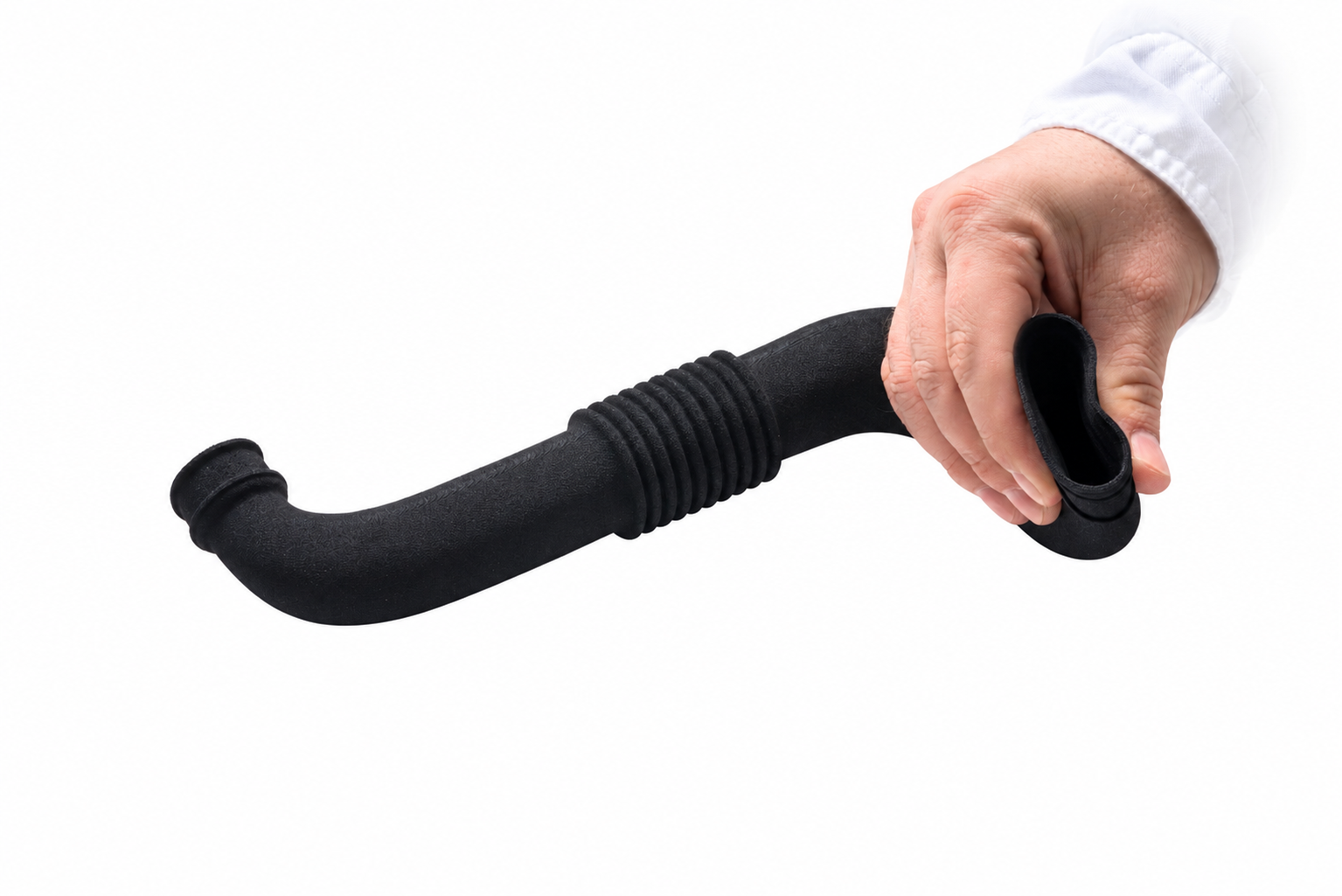
Adapted to the installation space
The length, bend, and connection points can be adjusted to fit the available space in the dashboard.
When developing a new vehicle model, air must flow reliably from the air conditioning unit to the vents in the dashboard. However, cables, control modules, and other components share the available installation space there.
A rigid connecting hose does not always fit the actual installation situation. A flexible hose can compensate for the necessary offset between the connections and adapt to the existing geometry. This allows testing during the prototyping phase to verify whether the airflow and installation in the vehicle function properly before the design is finalized for subsequent mass production.
Based on the connection points and the available installation space, the hose geometry is adjusted in CAD. The bend radius, length, and ribbed section are designed so that the component can be installed between the connections.
After the initial production run, the hose can be tested directly in the vehicle or on a test rig. If changes are needed, the geometry can be adjusted for the next variant without having to manufacture an injection-molding tool first.
TPU is elastic and suitable for components that are intended to deform or adapt to a specific installation situation. The SLS process also allows for the production of more complex hose geometries without the need for separate support structures. This makes the combination particularly appealing for prototypes and small-batch production. Hoffmann AM offers TPU as an SLS material.
TPU with a Shore hardness of 85A is suitable for this hose. The material is soft enough to compensate for misalignment between the connections and to be easily mounted onto the fittings. At the same time, it is firm enough that the cross-section remains open under the low pressure of an air conditioning blower. The ribbed section provides the actual flexibility. A harder TPU around 90A would only be necessary for long, freely suspended sections, very thin walls, or contact with edges.
Hoffmann AM offers Shore hardnesses ranging from 20A to 90D. This allows the hardness to be specifically tailored to the application: from very soft parts for seals and dampers to rigid, dimensionally stable components.
For use in vehicles, however, the material and component must still meet the actual requirements. These include, for example, temperature, airflow, continuous stress, and, where applicable, specifications regarding flammability or interior emissions.

The hose is manufactured using the SLS process from TPU with a Shore hardness of 85A and tested directly in the vehicle or on a test rig.
|
Manufacturing Data Material Shore hardness Process Quantity Industry |
Application
|
The length, bend, and connection points can be adjusted to fit the available space in the dashboard.
The ribbed section of the hose can accommodate movement and installation misalignment. How well this works in a specific case is tested on the component.
Modified geometries can be produced for additional prototype parts or a small production run without first requiring an injection-molding tool.
It is usually slid onto the fittings with a slight overlap. A circumferential bead or a locking contour at the end of the hose provides additional support, and a hose clamp secures it against vibrations. These details can be incorporated directly into the CAD geometry.
For airflow at the low pressure generated by an air conditioning fan, the material’s airtightness is generally sufficient. However, laser-sintered TPU is not completely pore-free. For more demanding applications, the airtightness should be tested on a sample, as wall thickness and Shore hardness affect it.
Yes, the printed hose then serves as a verified template for geometry and installation. For large production runs, such a hose is usually blow-molded or injection-molded, which requires adapting the design to the mass-production process. For small production runs and replacement parts, 3D printing can remain the most cost-effective solution in the long term.
Read more: 3D Printing for the Automotive Industry
Whether it’s an air duct, a hose connection, or a protective component: Send us your CAD data and your requirements for installation space, temperature, and quantity. Together, we’ll determine whether TPU produced using the SLS process is suitable for your application.
Fislisbach, Switzerland