
<img height="1" width="1" src="https://www.facebook.com/tr?id=3900557156680409&amp;ev=PageView &amp;noscript=1">
Skip to content
HoG_Additive_Manufacturing_RGB_box-1
Technology

Selective Absorption Fusion (SAF)

Additive manufacturing process for plastics

Installation space

  • 315 x 208 x 293 mm

Applications

  • Series productions
  • Spare parts production
  • End user parts

Advantages

  • For plastic components with very high longevity and availability (reduction of downtimes).
  • For series production of components (more economical than other additive processes)

With SAF technology, an infraredsensitive High Absorbtion Fluid (HAF) is applied to the material powder which is then fused to the component with print heads. This works in detail as follows:

The powder of the corresponding material is distributed very evenly over the entire print bed with the BigWaveTM powder management system for each new print layer. Piezo-electric print heads are then used to apply the infraredsensitive HAF specifically to the powder  and the powder is later fused to form the component. Finally, this layer is exposed to infrared radiation, which causes the area where the HAF was applied to melt and bond. These three steps are repeated layer by layer until the entire component is printed.

These highly precisely distributed layers of powder prevent local overheating of the material. This ensures homogeneous material properties and high dimensional stability of the components.  The BigWaveTM system ensures that excess powder is directly recycled.  This minimises the thermal load on the powder (optimised powder aging) and requires less powder overall. The former has a positive influence on the mechanical component properties and the latter reduces the operating costs of the additive manufacturing process.

Suitable materials

Polyamide PA 11, 3d printing plastic, technology SAF

For plastic parts with very high durability and availability
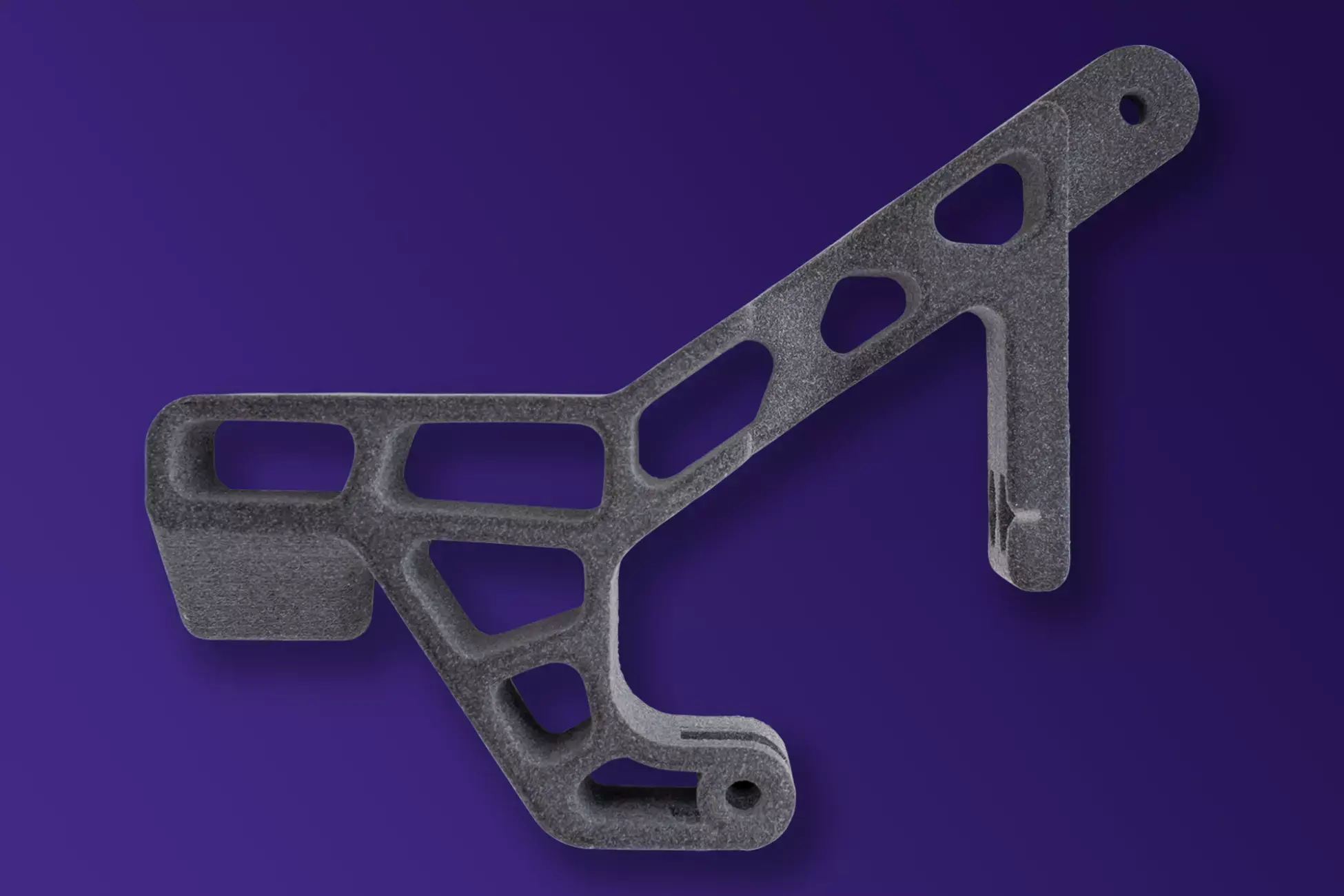
3D-Druck-Material-PA11-Technologie-SAF-Jellypipe-Ans1

Features:

  • Density [g/cm3] 0.99
  • Tensile strength [MPa] 48
  • E-Modulus [Gpa] 1.60
  • Heat deflection temp @0.45 MPa [°C] 185 (ASTM D648)
  • Elongation at break [%] 45
  • Shore Hardness 75D

Applications:

Plastic parts with very high durability and availability
Series components (cheaper in series than PA12)

Advantages:

  • Longevity
  • Production of larger quantities
  • High strength & stability
  • Flexible prototypes
  • Minimum wall thicknesses
  • Good resolution and detail
  • High diversity of variants
  • Versatile aftercare
  • No support material (support) necessary

PA 11 is usually obtained from castor oil and is an ecologically friendly product. It has better mechanical properties than petrochemically produced PA12: higher ductility, impact strength (notched impact strength), abrasion and fatigue resistance, improved isotropy, better chemical resistance. The temperature resistance of PA11 is comparable to PA12.


Note about material properties

Note: Please note that the listed values of the properties (e.g. tensile strength) refer to the properties of the material in an unprocessed state. Hoffmann AM can not guarantee the information below. In the printed state, the values may deviate from the specifications.

If a material in practice is pushed to the limits of the stated values, the component itself should be tested. If you have any questions, please do not hesitate to contact us.